Anyone who has interacted with me the last 3.5 months is likely to have heard that job searching is hard right now. Some describe it as a nightmare, saying that it’s harder than ever. There are so many stories of people who have been out of work for months and years.
This post covers my perspective on why, what you can do, and my journey finding a job in mid-2026.
Why it’s so hard
There are a lot of reasons why it’s especially hard right now, where these are just the tip of the iceberg:
- Hundreds of thousands of people have been laid off just this year (especially in the tech industry), making it more of an “employer’s market” and increasing competition.
- Job salaries in many areas have gone down. For example, some support folks are telling me they’re seeing the same job have a lower salary range than 2-5 years ago. Meaning, if you’re only applying to roles that provide the same salary you last had, the pool of opportunities is significantly smaller.
- Roughly half of the applications received for a job posting are ‘fake’ AI generated ones (either there is no human, or the person doesn’t have the experience/skills listed). Many companies use an anti-AI filter, so be careful about using AI to write your application even if everything in it is true.
- Organizations are getting hundreds or thousands of applications for a single job posting. That means even with an anti-AI filter cutting out possibly half, there are typically too many for them to review them all.
- Many organizations are only hiring Senior level or higher.
- Many organizations have moved to hybrid or in-office, with a significantly lower percentage jobs that allow fully remote compared to 3-5 years ago.
- The list goes on.
As a result of the current hiring environment, my job coach told me during one of our first meetings that only about 10% of job offers originate from people applying “cold”, meaning without using their network to endorse or refer them. It’s almost impossible to get to the first stage of the process without someone pointing out your application to a human (more on this later).
Mental toll
Beyond just worrying about job fit, how best to customize an application, and all the usual things we would already about, we now have to worry about getting past the anti-AI filter and the criteria matching filter.
It’s also worrying that there are so many stories now of people being unemployed for years, or need money badly enough to apply to minimum wage jobs (and then not get them because they’re too experienced). I consider myself lucky that in Canada, we have employment insurance and it covers you for at least 3 months, though typically longer if you’ve been working full time. Still, that’s not going to be longer than a year.
Everyone always says that job searching is basically a full time job in and of itself. So, many recommend taking a break, or doing it part time while spending time with family/friends and doing things that you enjoy. Even if you decide to work on it full time, definitely set yourself a schedule so that you’re not doing more than full-time hours. It would be ironic to burnout searching for a job. And if you need a break before starting a new job, consider negotiating a later start date.
Personally, this is also the first time I’ve been laid off. Even when I purposely took a break from employment, I actively searched for less than a month and signed an offer 3 months after the last day on the previous job.
With the uncertainty in today’s job market, I think the toll on mental health is much higher than in the past. I’ve seen a lot of people pivot to something else, especially something more hands-on or that directly benefits their local community. For anyone who is passionate about something, it’s probably a good time to move to that instead.
How applying to jobs has changed
In 2026:
only about 10% of job offers originate from people applying “cold”. (Source: my job coach)
Based on everything I’ve read and heard this year, I wouldn’t be surprised if it’s true. The better and more popular (while being well-reputed) the organization, the more likely they’re being inundated with applications. Even if they have an anti-AI filter to cut down the numbers in half, a single position can generate hundreds of applications.
I’ve broken the guidance and tips into sections, so feel free to skip any sections you think you already know.
Choosing which jobs to apply to
I can’t count the number of times that I’ve heard the advice on quality over quantity when it comes to applying to jobs. Meaning, put in the effort to cater each application to the job description instead of sending in the same thing to all the jobs.
At the same time, customizing applications takes up time, so you want to considerately choose which jobs to apply to. Most guidance I’ve heard/read says to apply to those that either fit your experience/skills, or that excite you / you’re passionate about; ignoring everything else.
While I’ve always encouraged people to apply to jobs even if they don’t meet all the criteria, it should still be a job you would want to do, something that motivates or excites you. After all, it’s something you will be doing every work day for likely years. Unless you have no choice, I can’t imagine you want a job that you don’t like.
In the current job market, you’re much less likely to get a role where you can’t convince people you really want the job during the hiring process if you don’t meet most of the requirements already.
Keeping an eye out for scams
If the job seems too good to be true (pay is significantly higher than most for the same job), then it probably is. There are more scams than ever, so it’s good to be careful.
Hopefully obvious that if a “recruiter” asks for any personal information beyond what would typically be included in an application, then it’s highly likely a scam. If they ask you for money, then it’s definitely a scam.
For companies I’ve never heard of, I’ll check their website to see if they have a careers page, and check LinkedIn to see how many profiles say work at the organization. You can also check when the organization page was verified (on the About tab). Of course, since profiles are trivially faked, see if any of the profiles are 1st or 2nd connections. You can check when a specific profile was created under the ellipse menu (next to the action buttons like Connect/Follow) > “About this member”. If you scroll down to someone’s experience and it’s AI generated, sometimes it’s fairly obvious.
If you’re asked to do an assignment, be careful opening files. Of course, don’t install anything that isn’t from a verified trusted source. If possible, install it inside of a VM or container.
Using AI
From what I can tell, using AI can be a double-edged sword.
Most application tracking systems (ATS) have anti-AI filters now. They’re trying to block the applications that are purely auto-AI generated because most of them are fake. It also means that a real humans (not faking their applications) should be wary of using AI to write their job applications for them, even if they’re customized to the job posting. A lot of AI tools write in a similar way, and your application could be caught in the anti-AI filter if the style of writing too closely resembles them.
Instead of asking AI to write or generate text for you, consider asking it to review your application. Is anything missing or not covered compared to the job posting? If you give the AI tool your full work history, are there more relevant parts of your experience that would be better suited? Is anything written in such a way as to be unclear to the reader? Is there anything it would change to more likely get through ATS filters?
I recommend noting any application that you manage to get through “cold” as it may be an indication that it got through the filters.
Getting human eyes
To consider hundreds or thousands of applications, organizations have used criteria filters for decades. At the beginning, they were fairly dumb, just doing keyword matching, whether exact or fuzzy (and those still exist of course). AI tooling has helped in recognizing similarities. For example, client vs. customer vs. user, where different words likely have the same general meaning. However, it’s unlikely that it will be able to recognize what experience from an applicant has the right transferable skills. You need to do that as much as possible in your application based on the job posting.
When an organization has so many applications to review though, it’s very easy to overlook a very good applicant.
That means, you need ways to significantly increase the likelihood of a human reviewing and possibly taking a closer look at your application. You might:
- Get a referral from someone at the organization.
- If you can’t get a referral, ask for an endorsement. Basically, that person would contact the recruiter or hiring manager with a positive note, but without having to pledge that they know you would be good for the role.
- If an endorsement isn’t possible, ask if they can simply point out or flag your application for someone to review.
- If you’re not connected to anyone at the organization, see if you have a second connection there, and see if your connection will message the recruiter or hiring manager on your behalf. Ideally, you would write a message that they can send to the person. Alternatively, the mutual connection can start a group chat or email thread with both of you.
- On LinkedIn, if you pay for Premium or the person pays for Premium and allows it, you can message the person directly. (This is not an endorsement to pay for it though.)
- If the recruiter or hiring manager posted the job, tag them in a comment saying that you applied and a sentence on why you’re interested.
- If you’re not sure who the recruiter is, on LinkedIn, you can search “People” using
Title:(recruiter OR talent OR recruiter OR recruit)and filtering “Current company” to the organization. Many recruiters list the department they’re recruiting for in their byline, job title, or job description. Otherwise, try any that are closest to you (1st or 2nd connection).
If you’re messaging a recruiter or hiring manager, don’t necessarily expect an answer. They’re likely getting flooded with messages. However, many recruiters have mentioned that even if they don’t have time to respond, if you message them, they will look up your application and review it.
To stand out, instead of just a generic “could you look at it” message, consider including a sentence on what interests you about the role or organization.
Job boards
There are so many job boards out there. Some require you to sign up for an account. Some even ask you to pay for access. Everyone I’ve spoken to says paying for access is not worth it though.
Some let you set up an email notification or RSS feed based on your search criteria which is nice.
My recommendation is to try a bunch, but whittle it down to a handful as you review the results and see which job boards you’re actually getting viable ones for you to apply to. Consider keeping track early on while you’re evaluating which sites to keep looking at.
I also recommend checking on a schedule: once a day, once every two days, or Monday-Wednesday-Friday. Often enough to catch the job postings early, but not so often that you’re wasting your time checking those that don’t have notifications and no new postings.
Here is a list of the ones that I used based on what seems better for remote jobs available in Canada, where you can save your searches (by creating an account, or copying the URL):
- https://www.welcometothejungle.com
- https://my.greenhouse.io
- https://signed.careers
- https://hiringcafe.com
- https://ca.indeed.com
- https://www.remoterocketship.com
- https://remote.com
- https://www.workingnomads.com (daily notification)
- https://www.jobbank.gc.ca/ (RSS feed)
Especially if you’re in a different country, you may find more success with others. Here’s a list of lists, and other ones that were recommended to me not mentioned in those:
- https://www.ziprecruiter.com/
- https://www.skipthedrive.com/
- https://remotejobsfinder.co/
- https://www.jobleads.com/
- https://posthog.com/cool-tech-jobs
- https://devtooljobs.hackmamba.io/
- List: https://theremotehive.com/resources/
- List: https://www.linkedin.com/posts/guptanikita16_remote-hybrid-3-days-in-office-we-share-7473993058368524288-K5et/
Many organizations do not post on job boards at all, so see if their jobs page allows you to set up a notification. Alternatively, you may be able to set up a custom RSS feed or similar to notify you when a new job is posted on a webpage for the specific organizations that you’re particularly interested in.
Case in point, the one I found was by searching the careers page of the company one of my friends/former coworkers moved to.
Job services
I won’t go into detail here, but someone was asking about it, so I’ve included this section.
There are a lot of job services out there, but two main categories that are commonly discussed:
- Staffing agency (where you might pay for a company to find you a role)
- Career / Job coaching
While looking for a job yourself, you’re unlikely to want to pay someone else to try to match you with a job. However, I have heard some people having success with it in countries where jobs are less likely to be advertised in. For example, if you’re targeting a job at a (US) tech company, and you live in Africa or Latin America. I’m a bit skeptical, but I don’t live in those areas. Most job boards let you choose your location/country, so generally, there shouldn’t be issues filtering job boards for jobs that you can apply to.
As to career/job coaching services, that really depends on you. If you’re starting from scratch, a career/job coach can be really helpful to help build the base version of your application that you would adapt for individual job postings. Some offer personal branding, and LinkedIn profile assistance. If you meet with a coach regularly, they can also be very good at asking you questions to help you reflect and improve during the job search.
Personally, I found the resume critique that I got early on to be very valuable, and much better than anything an AI could do. I thought my resume writing skills were okay, but my job coach definitely improved it. I also appreciated having someone with industry knowledge. For example, she shared that the main reason she has her Project Management certification (PMP) is because you can get a significantly higher salary in the same role with it. So, even if I didn’t want to pay for the certification testing, if I complete the necessary online courses in preparation, I can mention that I’d be ready to take the test in my application and interviews.
My 3.5 months journey
People who know when I was laid off might be wondering why it’s not 4 months. Since I was on vacation at the time, I spent a few days trying to enjoy the vacation, then spent a week not actively looking but applying to a few jobs that were sent my way. I didn’t start actively looking until after I returned home.
No surprise, it was stressful. I mentioned earlier the mental toll from hearing stories and personally knowing others who have been out of work for over a year. Getting rejection emails sucked but not as much as the rejections after going through most or all the interviews. I estimate a rejection after multiple interviews hit as hard as or more so than 5 rejections after just applying. After all the interviews, it’s probably more like 8 or more.
One of the parts that really made this tough is getting ghosted even when someone referred me. You’d think they could at least send a generic rejection email. At 100+ days later, I’m not holding my breath.
For some context, I applied to tech companies in various industries for fully remote support, operations, and program/project management roles. Actually, I applied to a couple of local hybrid jobs, but only local ones, and not fully in-office. I do not want to deal with traffic every day after working remote for years, and I’m not moving either. I’d be willing to do in-office if public transit were an option, but there is no transit service at all in my area.
Difficulties with support roles
One of the hardest parts with support roles is the varying titles and technical requirements. Some said support or customer-facing experience required but not how many years. Support can include everything from answering simple questions (typically with a minimum number of tickets answers, such as 100+ per day) to Tier 3 troubleshooting with bug fix code contributions.
It didn’t help that many did not list a salary (which organizations are actually legally required to do if the job is open to people in BC). I understand if it’s a worldwide remote job with location factor that can be difficult to do, but they could post the US only range with a note that location is a significant factor in salary. Some support roles have very generic descriptions, so salary can be a very good indication of expectations. A lot of places ask for your expected salary, but then they’re just wasting resources even accepting the applications, and putting additional burden on the candidate to apply.
But, you know, a job is a job. I didn’t keep track, but I’m fairly sure more than half the places I applied to did not have a salary posted.
Hiring process as a reflection of the company
It’s always been true that the interviews are how you get to know who you’ll be reporting to and what it might be like to work at an organization.
What’s been a bit different this time around is that I’ve heard a lot of people say the hiring process is something they consider a reflection of the organization. When you think about it, it’s true that if the company lets the hiring process slide, they may be letting other things slide as well. Nevertheless, I’ve worked in a lot of organizations where the hiring process is not great, but on the job, your manager makes the biggest difference in job satisfaction. Of course, there’s a limit to what should be expected.
The best and the worst
The worst experiences I had:
- recruiter refused to move me forward after asking me a single interview-style question. Their reasoning was that I didn’t give a technical enough example with enough details. I specifically prefaced my answer that it was more focused on the cross-collaboration piece, and that I could provide a different example if they wanted something more technical. They didn’t ask for it.
- ghosted after doing a recruiter call and take home.
- getting a generic rejection after doing the take home and seeing the job reposted again and again. (It may be a case of using the take home to get people to do free work, but that’s purely speculation.)
- being given 3 days to do a take home that took me 2.5 days, which involved coding, documentation, too many customer ticket responses, escalation reports, a video to walk through the whole thing, and more. (In contrast, most take homes were 2-5 days to complete a 2-4 hour assignment.)
- after doing a take home (which took an hour?), I got a recruiter call saying the pay is US federal minimum wage. I told him during the call that they should not be accepting applications from Canada or any US state where the minimum wage is higher. (Everyone that saw my message in group chats commented that minimum wage jobs shouldn’t expect you to pass a take home either.)
The best experiences I had:
- superb recruiters who were clearly interested in your success (not just what the company needed), clearly outlining what to expect, and providing feedback.
- recruiters who obviously listened when talking about timeline. (Think being on track to get through the whole process in less than 3 weeks.)
- friendly interviewers who outlined the plan for the current interview, asked clarifying questions, clearly listened (as opposed to having specific answers in mind), and provided feedback. (I’m not talking about providing their decision immediately, but rather giving signs or responses that indicate if you’re on the right track with the kinds of answers you’re providing.)
I’ve heard stories of stuff that’s better and way worse, but the lists are based on what I personally experienced. If you’ve been job searching, I would love to hear your best and worst stories.
The numbers
I promised some folks that I would share my numbers.
From talking to others, it seems true that if you don’t get contacted for a call after a week, you’re unlikely to move forward.
ShortestAverageLongest
| Request for call | 0 days | 6 days | 18 days |
| Immediate rejection | 0 days | 24 days | 75 days |
For this particular table above, I’ve excluded the recruiter call I got 30 days after applying because it was for government in a different area than all the other jobs I applied for.
The longest interval until rejection makes me wonder how much longer I will be getting rejection emails after this.
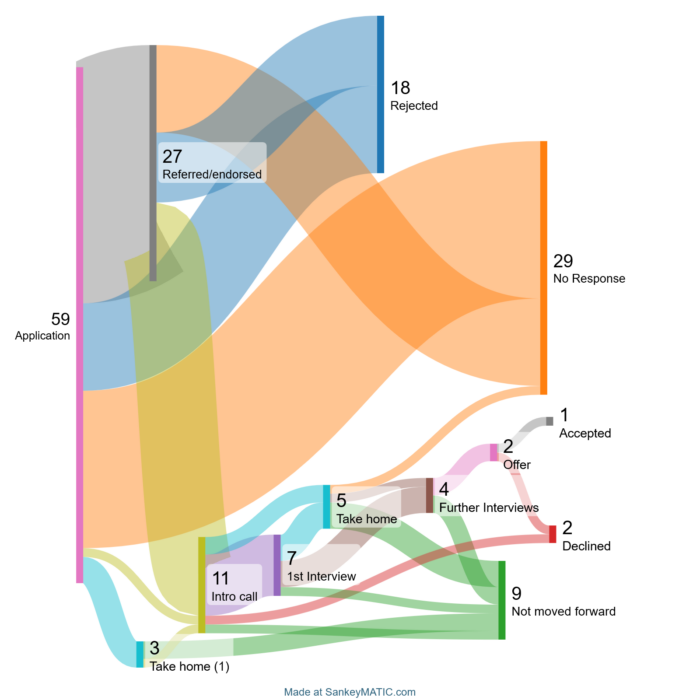
Notes:
- Take home (1) = Take home was the first stage of the process after application. Having it as the same node as “Take home” made Sankey very unhappy.
- Intro call = typically recruiter call, but was sometimes done by the hiring manager.
- “Referred/endorsed” to “No Response” = 10, which is so sad. More than a third of jobs where someone referred/endorsed me ended up ghosting me.
- A response rate of around 50% seems to be the norm from those I spoke to. In the end, mine was 54%.
The total number of applications isn’t that high, but I focused on entry to mid level for program/project management (dismissing senior level), and more technical senior level for support (dismissing entry-level or non-technical roles).
I also customized every job application. Sometimes if the job description was almost exactly the same as another, I’d spend just a little bit of time tweaking it. Other times, I’d spend hours writing a very different resume and cover letter. For the amount of time I’ve been searching, I think that’s a “decent” number.
Offer signed
I’ve been told that 3.5 months is “fast” in the current job market for getting a new job. Whether that’s true or not, I’m happy to be able to say I signed an offer!
Truly thanks to everyone who provided support: whether that’s a referral/endorsement (directly or indirectly), sending a job posting my way (even if I didn’t apply), listening to be complain/vent, commiserating, or just sending a supportive message.
I look forward to the new role and company. I’ll post about it in the near future on the socials.