Doors Open Ottawa 2011 (Part 1)

It was actually two weekends ago now that Doors Open Ottawa 2011 happened (June 4-5). Although it doesn’t quite fit in with the usual library related things I post, it was too cool of an experience not to blog about it.

A quick list of first half of the places I visited (in alphabetical order):

I somehow did all of this in one weekend. Took a day pass, a map, and a bit of planning, but it worked! Be warned: this post will be fairly image heavy. In visited order:


View Doors Open in a larger map

Billings Bridge Artifact Collection (Routhier Community Centre)

Billings Bridge Estate chair and pianoBillings Family Photos

This was a neat little collection of various furnishings and other items that are part of the Billings Bridge collection (exhibited at times at Billings Bridge Estate. I admit that after seeing the LAC Preservation Centre, the storage facility itself was not particularly impressive, but they definitely thought it through (complete with raised floors, humdifier, temperature control, and flood detectors). Nevertheless, as they recently redid the museum to be less showing of what it was like in the old times to more interactive screens/videos, it was nice to have the opportunity to see some of Ottawa’s history.

Blackburn Building

Blackburn Building
The Blackburn Building is really just an apartment building, but the indoor courtyard done in the Art Deco style was neat.

Bytown Museum & Rideau Canal

Bytown Museum and Rideau Canal

Bytown Museum was very interesting as the tour guide gave us a quick history of Ottawa, focusing on how Ottawa started as Bytown, the building of the Canal, and then how it got renamed. In doing so, she also talked about why the Bytown Museum (which was a warehouse and guardhouse) is the only building in Ottawa in the Georgian style architecture (though not quite true to it). Apparently, the Rideau Canal took so long to build, by the time it was done, the Georgian period had passed. While there, I also happened to see one of the Rideau Canal gates open and close. Not something you see everyday!

Carriageway

Dragon Lamp

This is actually restored building done in the Georgian style as the original was burnt down in 1978. It mostly has offices with some retail on the ground floor. This was another building that had balconies and walkways indoors (much like Blackburn), plus some neat lamp decorations.

C.D. Howe (green roof)

C.D. Howe Green Roof

C.D. Howe is the Public Works and Government Services Canada (PWGSC) building with retail shops on the lower levels. The building itself, however, was not the point of visiting the building, but rather to see Ottawa’s first ever green roof. The initiative is great for not only having a nice place to lounge with greenery for wildlife, it also helps to reduce energy use and the heat in cities.

Delegation of the Ismaili Imamat

Islamic Delegation building foyer
The Delegation of the Ismaili Imamat building was really neat. Of all the modern buildings I saw, I think I enjoyed this one the most. Other than the impressive dome, the metalwork you see around the foyer area is inspired by Islamic art created as a sort of screen where it is easy for those on the upper floor to see into the open space, but difficult for someone on the ground floor to see up to the balcony-like upper floor.

Islamic Delegation Courtyard

The courtyard was interesting too since originally it was supposed to have a fountain, but for whatever reason they could not put one in. So the architect found different ways to include water thematically. The courtyard floor is slanted so that water will collect in the center and drain away. The floor is even heated to accelerate the melting of snow during winter. The bushes are also shaped into a wave pattern so that when it snows, it becomes quite obvious.

Embassy of France

I hadn’t really planned on going to the Embassy of France, but I’m glad I did. It’s a modern building as you can see from the images. The tapestries were very impressive: very large, well made, and some are quite old. The wall sculpture decorations were very nice as well. I thought the mix of decor styles was quite interesting. My only problem with the experience was that I felt like part of a herd.

Originally, I was going to post all the places, but the post was getting way too long. Stay tuned for Part 2.
MediaWiki Image Link Workaround

So, in playing around with my user page and trying to make it look pretty, I found out that you can link an image to an internal or external link like you might normally do instead of the File: page. That’s great, but the problem I found was that except for the basic internal and external link, when you linked the image to something that inherently has a little icon next to it (e.g. mailto link gives you a little e-mail icon), then it would show the icon next to the image (see below left).

So, it turns out that there is a workaround to hide the icon (see above right). You can add this bit of code to the main.css file:

#bodyContent .plainlinks a {
background: none repeat scroll 0 0 transparent !important;
padding: 0 !important;
}

Or if the CSS Extension is installed, you can hack it by using the same code, but you’ll probably want it to be context dependent if you can.

Library and Archives Canada (LAC) Preservation Centre

So our group actually went on this tour back on May 18th, but I somewhat forgot to write about it.

I apologize for lack of pictures. We weren’t really allowed to take anything in with us, so the best I can do is describe it. Click on the image below though, they have a few pictures on their own site.

Library and Archives Canada Preservation Centre

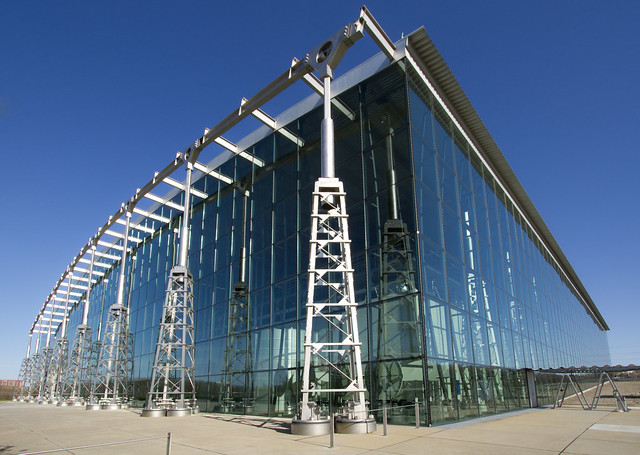
The architecture is really interesting since it’s inspired by the Prairies. The towers look like oil rigs, and the various connected buildings in and outside look like barns or silos. The Centre itself is also separated into two sections. The inside vault is basically in a big cement block and then there’s a large hallway space with a glass building surrounding it. To give you perspective on the size, it’s two football fields big and could fit 2 boeing 747s if the vault wasn’t in it.

The inside has 4 floors of vault and then an open floor above for work areas. Each vault floor has numerous vaults separated into rectangular rooms much like most places that store materials. Humidity and temperature is different depending on the format of the material inside as to be expected. Audio/video is of course as challenge due to the shifts in format/technology. The paintings are pretty neat. There were a number of Laurier portraits, the Churchill one was nice, and copies of the original Proclamation of the Constitution Act. The original we’ve been told is in a top secret vault (no kidding).

Proclamation of the Constitution Act

The top floor is the “village” where they have little huts with all the equipment they need to do restoration, preservation, and format transfers. They’re considered huts since they can be reconfigured (I imagine they don’t do it all that often though). Particularly neat was the page remaking process where they remake and fill in what’s missing of each page from a book, and also the cover remaking/rebinding. We got to watch a short video on the comparison between before and after a film restoration which was pretty cool.

It was a very cool tour. It’s definitely worth going if you have time!

Adjusting Management Styles and Organizational Cultures

I’m sure everyone has experienced it when they change jobs. Everyone has experienced the shift and the need to adjust to a new job, manager/supervisor, and organization. I think what’s really hit me is that I’ve gone from one end to the pendulum to the complete opposite (or so it seems).

Management

At my old job, I was basically given a one liner on what I should be doing, “go do x, and if you don’t know how, just read up on it and give it a go.” If I needed help though, my coworkers would be more than happy to. I used my time as I saw fit in working on projects, and attended workshops on campus.

Now, I get lots of detail on what is being asked of me. I also send everything to be vetted by my manager and sometimes other coworkers. I keep a list of everything I’m working on and completed as well. I ask permission to go to anything my manager hasn’t directly sent me to.

Organization

In general, yes, things were divided by units or departments, but we got good response time for the most part and had a fair amount of control over what we could do. It was fairly easy to contact people and find out what information you wanted or needed.

Now, things are not only divided, things sometimes frustrate me, because we get minimal to little support in some areas. I also find it difficult to get information, having to through unusual ways to get it frequently. Though I admit, I think a lot of it is having no control and being allowed to be given any. It’s irking especially to know that you could probably fix it yourself, but it’s not your job. Then again, it seems I’ve just been “lucky” to encounter a number of issues and it’s not that common for a lot of the little things to happen that have been bothering me. Don’t get me wrong, a lot of things do go very well. I have found people very helpful and willing to help, and IT help desk is great!

Conclusion

There is no better, just different and what fits better with your work style.


general, yes, things were divided by units or departments, but we got good response time for the most part and had a fair amount of control over what we could do. It was fairly easy to contact people and find out what information you wanted or needed.

What do you call a wiki moderator?

Just a quick post.

At my old work, wiki moderators = wiki gardeners.

At my new work, wiki moderators = wiki gnomes.

Interesting that they all refer to gardening in some way, but I suppose that’s just a general wiki trend. I think I like the gardener title better, but gnomes definitely allows for some interesting pictures.